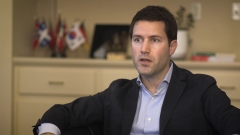
Monterey Institute Experts, Including a Student, in the Spotlight After Boston Bombings, Ricin Letters
National events once again drew media attention to the Monterey Institute’s unique international...
Talking about the global reputation of the Monterey Institute’s James Martin Center for Nonproliferation Studies is one thing; having it convincingly demonstrated is quite another. As of June 2010, MIIS/CNS students will occupy almost a full quarter of the total number of positions in one of the nation’s most prestigious government-sponsored nonproliferation fellowship program.
Two experts from the Monterey Institute’s James Martin Center for Nonproliferation Studies (CNS) are quoted in an Associated Press article about Iran’s acquisition of sensitive nuclear equipment that is being syndicated across the globe. The story traces the sale of pressure transducers – vital for uranium enrichment – by a Swiss manufacturer to a company in Taiwan, which resold them to a counterpart in China, which then sold them to an industrial manufacturing firm in Iran.
Highlights of recent activities by the faculty and staff of the James Martin Center for Nonproliferation Studies include the folliowing:
Monterey Institute faculty members Kenneth Coleman and Raymond Zilinskas of the James Martin Center for Nonproliferation Studies were recently referenced in an article about Botox as a bio-weapon.
Jonathan Tucker, a senior fellow at the Washington, D.C. location of the James Martin Center for Nonproliferation Studies, was quoted in an Associated Press article about the execution of “Chemical Ali,” or Ali Hassan al-Majid, a cousin and close cohort of Saddam Hussein who used chemical weapons to kill thousands of civilians during the dictator’s regime.
Dr. William C. Potter, director of the Monterey Institute’s James Martin Center for Nonproliferation Studies (CNS), will testify before the House Committee on Foreign Affairs this Friday at a special hearing addressing “The Impact of U.S. Export Controls on National Security, Science and Technological Leadership.”
Senior research Associate Miles Pomper of the Monterey Institute’s James Martin Center for Nonproliferation Studies was quoted by two publications this week commenting on the prospects for a successful near-term conclusion of the much-delayed START treaty renewal talks between the United States and Russia.
Leading international affairs journal Foreign Policy recently published a piece written by Senior Research Associate Chen Kane of the Monterey Institute’s James Martin Center for Nonproliferation Studies. Reviewing the nuclear capabilities and ambitions of various Middle Eastern states, Kane notes that “the global economic crisis has disrupted the calculus of nuclear power.