Head of International Atomic Energy Agency Speaks to MIIS Nonproliferation Students
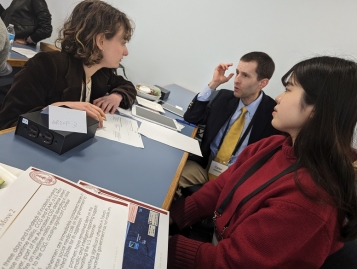
Ambassador Yukiya Amano, the newly-elected director general of the International Atomic Energy Agency, visited the Monterey Institute last week after participating in the Nuclear Security Summit in Washington DC. A former diplomat-in-residence at the Institute’s James Martin Center for Nonproliferation Studies (CNS), Director General Amano spoke to a large group of Monterey Institute students on April 16 in a class conducted by Ms. Gaukhar Mukhatzhanova on nuclear proliferation trends and trigger events.
NY Times Profiles Former Monterey Institute Faculty Member, Assemblyman Bill Monning
In an April 18 article, the New York Times cites Assemblymember Bill Monning´s experience as teacher of international negotiation and conflict resolution at the Monterey Institute of International Studies as one of the assets he will bring to the task of implementing federal health care reform at the state level.
4/22-23: U.S., Russian High School Students Present Views on Nuclear Disarmament Issues at Monterey Forum
The annual Critical Issues Forum conference culminates a year-long program designed to increase high school students’ awareness of nonproliferation and disarmament issues and enhance critical thinking skills by giving students from both the U.S. and Russia the opportunity to work with nonproliferation experts from the Monterey Institute of International Studies’ James Martin Center for Nonproliferation Studies (CNS).
Nuclear Summit in Washington Fuels Global Media Interest in CNS Experts
Nonproliferation experts from the Monterey Institute’s James Martin Center for Nonproliferation Studies (CNS) have been quoted in major media around the globe in recent days on nuclear disarmament related issues:
MIIS, CNS Experts in Demand as Terrorism, Nuclear Strategy Make the Headlines
On April 7 Stephen I. Schwartz of the Monterey Institute’s James Martin Center for Nonproliferation Studies (CNS) was quoted by TIME in an article about President Obama’s Nuclear Strategy: What’s Changed, What Hasn’t.
4/13: Guest Lecturer David Rutledge to Address “The Coal Question,” Energy Policy and Climate Change
California Institute of Technology Professor David Rutledge will deliver a guest lecture on “Hubbert’s Peak, The Coal Question, and Climate Change” on Tuesday, April 13 at 6:30 p.m. on the Monterey Institute of International Studies’ downtown campus. Professor Rutledge will discuss the varying estimates of peak coal production in the United States, and the implications of dwindling coal reserves for energy policy and climate change.
NY Times, ABC News and International News Agencies Quote MIIS Experts on START Follow-On Treaty
Today the New York Times turned to former Russian arms control negotiator and current Monterey Institute research associate Nikolai Sokov, to put the START follow-on treaty into perspective for its readers. Dr. Sokov participated in the START I and START II negotiations on behalf of Russia and is now a senior research associate at the Institute’s James Martin Center for Nonproliferation Studies (CNS).
Time, Washington Post, Huffington Post Quote MIIS, CNS Experts
The Monterey Institute of International Studies (MIIS) and the Institute’s James Martin Center for Nonproliferation Studies (CNS) have been in the mainstream media eye three times over the past eight days:
-- A March 14 Washington Post story reporting on a new written account by infamous Pakistani nuclear scientist A.Q. Khan of Iran’s attempts to acquire nuclear weapons technology quotes CNS Deputy Director Leonard Spector on Khan’s dealings.
Monterey Institute and American University in Cairo Sign MOU Promoting Exchanges, Collaboration
President Sunder Ramaswamy signed a memorandum of understanding (MOU) with the American University in Cairo yesterday designed to expand ties and exchanges between the two schools. The agreement calls for the two institutions to cultivate academic and educational cooperation, support collaborative research, professional internships and technical cooperation, and promote sustainable partnerships that may include exchanges of graduate students, faculty, academic materials, and publications.