
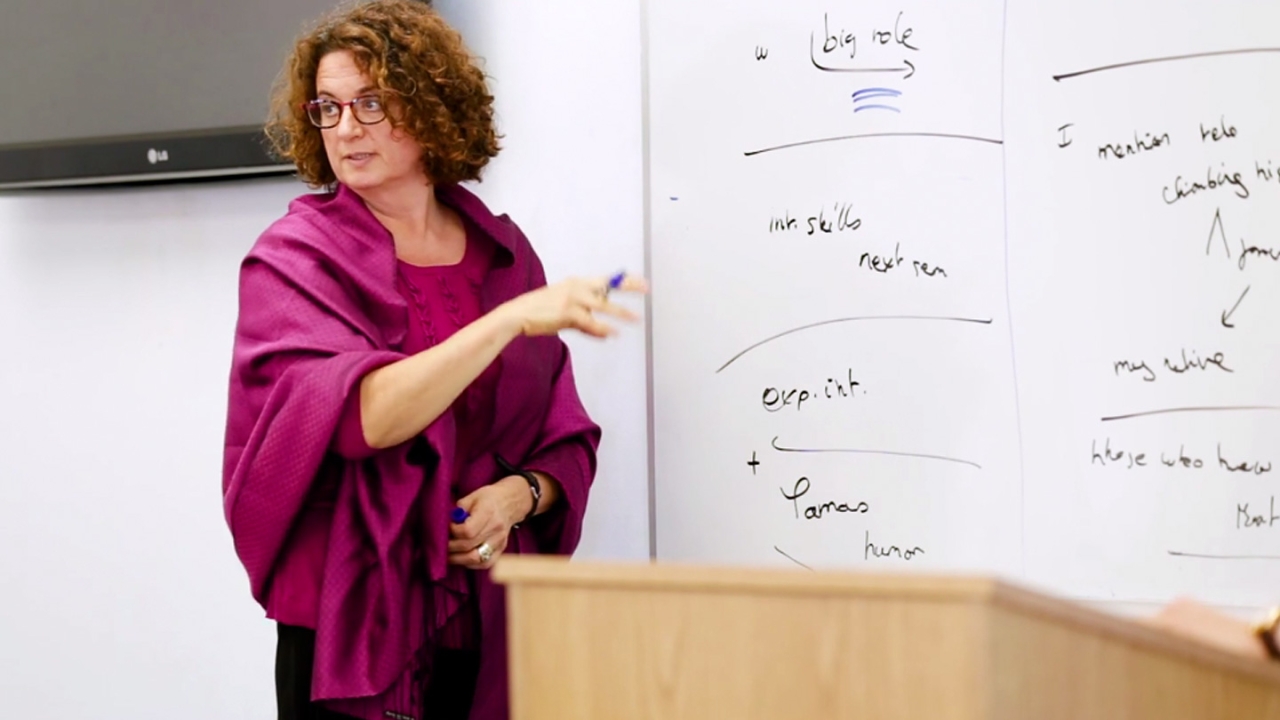
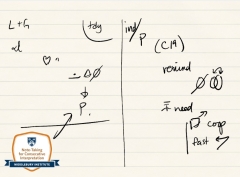
New Short Course on Note-Taking for Consecutive Interpreting
| by Sierra Abukins
The self-paced online course is taught by Professor Laura Burian and helps you build the foundation to build a strong note-taking practice over time.
Launch your career in the $60 billion language services industry with a master’s from one of the world’s leading graduate schools for translation and interpretation.
Our translation and interpretation master’s degrees prepare you for exciting careers as freelance or in-house language professionals at organizations like the United Nations, the U.S. State Department, the Stanford Healthcare network, and a range of NGOs and private companies around the world.
You can pursue a Master of Arts in Translation (T), a Master of Arts in Translation and Interpretation (TI), or a Master of Arts in Conference Interpretation (CI).
| Start Term | Credits | Duration | In-Person |
|---|---|---|---|
| Fall | 60 | 4 semesters | Monterey, California |
At the Middlebury Institute, we offer an MA in translation and and MA in translation and interpretation, and an MA in conference interpretation. There is no where else where you can really get the professional training and the sound academic environment that we provide here at the institute, and for me that was the real draw. I really loved the blend of the academics and the professional and the type of professionals that it prepares for the world out there.
I chose this program because I want to be an interpreter and this is one of the best schools in the world. Here at the institute I learned how to interpret both consecutively and simultaneously in both directions into English and into Spanish.
In all of our classes, we’re asking students to engaged in activities that they’ll be engaged in as translators, interpreters and localization specialists. Whether they’re interpreting for international visitors or international conferences, localizing materials for various agencies, or translating documents for people.
Everything that they do is tied into their education and then of course provides them with those great experiences to put on their resume that they’ve done while they’re here with us.
My favorite class in the program is the practicum, interpretation practicum class, because that’s when we actually get to do real life assignments. We’re in the actual booth wearing headsets, speaking into the microphone, and sometimes people are actually relying on our interpretation to listen to the event.
I don’t think there are many places in the world where you can go and really find so many people, and pretty much everyone on campus has lived, worked and traveled overseas. And the multitude of languages spoken here is really impressive as well. And I think that makes for a very vibrant campus community. Everyone really has done fascinating things.
Knowing a language is also knowing about the culture. So it’s really helpful when you can actually interact with people coming from another country and to get to know them.
From the day students set foot on this campus, the faculty really treats them as colleagues. The programs are relatively short, and in two years, in fact if not sooner, our students and our colleagues are working together out there in the community. So I think that provides for really unique mentoring relationships.
The faculty here at the institute is very helpful and very accessible. They are working in the field, so they are translators and interpreters. So whenever we have a question related to the profession, they have the answer, and they are willing to help us become one of them, one of their colleagues.
This experience has been really life-changing to me because I was doing something else with my life before and now coming here I’m more sure than ever that I really want to do this for the rest of my life.
If you are looking to be a translator and interpreter, and be ready to start working once you graduate, this is the place where you wanna be.
Your career and academic advising are coordinated, ensuring you align your coursework with your career goals. Our experienced advisors will guide you from course registration to preparing for interviews, negotiating your employment offers, and managing your career.
Students often pursue internships during the summer between their first and second years.
Our annual language services career fair, hosted at our Monterey, California campus, attracts dozens of employers—like the U.S. Department of State Office of Language Services and Deluxe Media Inc.—all seeking to hire our students for internships and full-time positions.
Our large and influential alumni network is eager to help you take the next step in your career. They are thriving in careers around the world, meeting the growing and global demand for multilingual fluency in courts, hospitals, technology, and diplomacy.
Explore careers in translation and interpretation.
Our career-oriented course work prepares you for lifelong skill-building and professional growth. You will develop key skills both in and out of your A (native) and B (near-native) languages as you work with real-world texts, high-profile events, and live simulations in a variety of fields. You will also learn to use the latest translation and interpretation technology, software, and tools.
Engage in authentic translation and interpretation experiences through your practicum. A thesis option is available for those interested in pursuing an extended translation project.
See the curriculum for more details.
Although you must select a specific degree when you apply, you will be exposed to many aspects of both translation and interpretation during your first year. After these two semesters, you, your faculty, and your academic advisor will know more about your strengths and interests, and you can finalize your degree choice and focus your studies.
Explore your degree options.
The flexibility in our curriculum gives you opportunities to customize your degree through your languages of study, content area electives, a professional practicum, internships, intercultural competence courses, joint degrees, optional specializations, and advanced entry.
Check out the program details for your options.
Students entering any of the programs choose to focus on one (or two) of the following languages, all paired with English:
Earn two master’s degrees in three years by combining T, TI, or CI with the STEM-designated MA in Translation and Localization Management.
Learn more about joint master’s degrees.
You may be eligible to complete the degree in only two semesters depending on your academic and/or professional experience.
Learn more about advanced entry requirements.
Our faculty combine academic expertise with years of professional experience as translators and interpreters performing high profile work at intergovernmental organizations such as the United Nations, at the World Economic Forum, at the Olympics, for the White House, in the U.S. State Department, in the German Parliament, in literature and research, in nonprofit organizations, and in private businesses.
Together with career advisors, faculty mentor students to ensure that they receive the academic and professional experience that will help them realize their career goals.
We offer a variety of resources to make your program more affordable including merit, need-based, partner, and external scholarships for both U.S. and international students. Your personal enrollment advisor is also available to help you think through financing this important investment in your career development.
Learn more about scholarships, financial aid, and tuition costs.
We take a holistic approach when considering your application, looking at your academic background, international exposure, professional experience, and career goals. We welcome applicants with or without work experience, and our program has numerous opportunities for you to gain professional experience before you graduate. This approach aligns with the Institute’s core values of diversity, equity, and inclusion.
We do not require GRE or GMAT scores for our master’s programs but competitive scores may strengthen your application and positively influence scholarship decisions. You will submit a Language and Skills Test (LST) to demonstrate proficiency in each of your languages of study.
| by Sierra Abukins
The self-paced online course is taught by Professor Laura Burian and helps you build the foundation to build a strong note-taking practice over time.
| by Minting Lu
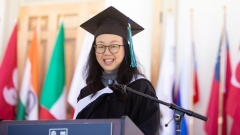
Barbara Zhang shares insights on how an organization that started in a crowdsourcing localization class at Middlebury Institute grew into a nonprofit that helps break down language barriers for seniors.

| by Charles Cai and Xiaohui Hu
Second-year interpretation students organized and led the annual Fall Forum, which was not only centered on a food theme this year, but featured seven local restaurants serving different cuisines.

Our graduates work globally as freelance consultants or in-house language professionals for private businesses, governments, and nongovernmental organizations.
How will you change the world?
Get InfoWhat makes us different?
Visit CampusNext Application Deadline: May 1
Apply Now