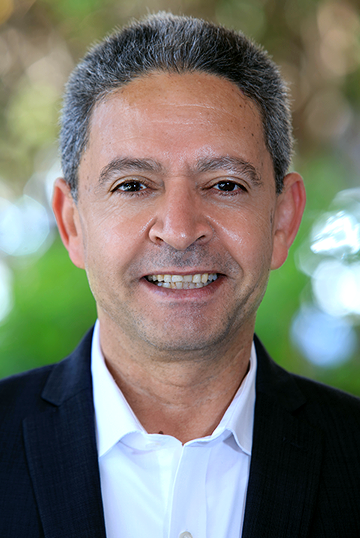
Mahmoud I. Abdalla
Associate Professor
Mahmoud Abdalla earned his M.A. and Ph.D. in applied linguistics at Essex University and the University of Edinburgh in the United Kingdom. He has taught and lectured extensively on linguistics, Arabic language, and Arab culture and media in several universities and academic institutions in Egypt, Europe, and the United States. He was previously the academic director of the Arabic Language Flagship Program and the coordinator of the Arabic Program in the Department of Linguistics and German, Slavic, Asian, and African Languages at Michigan State University. His research interests include second language acquisition, discourse analysis, heritage language learning, second language pedagogy, and language culture and identity. He is highly involved in teacher training, is a member of several academic associations, and serves on the executive board of the American Association of Teachers of Arabic. In 1999, he received the outstanding teaching award from the Council of Students of Arts and Sciences at Washington University in St. Louis. He also is a certified Oral Proficiency Interview (OPI) tester through the American Council on Teaching Foreign Languages (ACTFL).
Expertise
Arabic language, Arab culture and media, linguistics, second language acquisition, language culture and identity.
Courses
Courses offered in the past four years.
▲ indicates offered in the current term
▹ indicates offered in the upcoming term[s]
ARLA 8270 - Intro to the Arabic World
ARLA 8290 - Topics in Arab Culture
ARLA 8305 - Soc &Culture in Arab Countries
ARLA 8320 - Development of Arab Mass Media
SThe course will offer an overview of the history of Arab mass media and the role they play in contemporary Arab society. Students will read, watch and analyze authentic materials from various Arab newspapers, magazines, satellite TV stations, online programs, cinema and the like. Students will be exposed to discourse that is presented in Modern Standard Arabic and dialects.
Spring 2011 - MIIS, Spring 2013 - MIIS
ARLA 8331 - ModernEgypt &Role in ArabWorld
Students who enroll in this course will study Egypt’s leading role in the region. The curse will focus on the political and social changes that affect this role. This will be done through reading a collection of literary works, historical texts and current editorials and articles. Students will also watch and discuss documentary films that shed light on the problems that Egypt encounters.
Spring 2011 - MIIS
ARLA 8332 - Understanding the Arab World
ARLA 8335 - Events in the Middle East
ARLA 8341 - Economy of the Middle East
The course focuses on the economic development in the Middle East. It will also focus on the effect of Arab Spring on contemporary Arab society including social justice and economic growth. The commercial, financial and business relations between the Arab World and regional and international organizations will be discussed in this class. Students will practice using the target language in activities and tasks that include interviewing local businessmen, preparation of business proposals and designing blogs or websites that provide useful information about how to do business in the Middle East.
Spring 2012 - MIIS
ARLA 8343 - Glblizatn/Dvlpmnt InMiddleEast
ARLA 8352 - Arab American Relations
ARLA 8373 - ChangesInContmpraryArabSociety ▹
ARLA 8392 - Nat'l ID &Women's Status,M.E. ▹
ARLA 8393 - Politcs&Scurity-MultipolarWrld
This course will be a part of a larger Monterey Model curriculum arrangement, which will consist of three groups of students specializing in Arabic, Chinese and Russian languages and Area studies. The Monterey Model curriculum will be devised in a way that would allow students from different language groups and areas of expertise to come together several times during the semester in order to exchange their views and acquired knowledge pertinent to selected themes. Students, professors and invited distinguished experts will be discussing differences in public, media and governmental views related to important international events and role of languages in regional politics. An effort will be made to integrate various approaches to better understand domestic politics and foreign relations through cultural, historical and political discourse. Students will watch jointly news broadcasts in Arabic, Chinese and Russian in order to better grasp the role of mass media in China, Russia and Middle East. Students will acquire practical skills of working with interpreters and will prepare their own presentations for some plenary sessions where they will have to rely on assistance of interpreters to generate the discussion of their topics. The joint coordinated curriculum will consist of the following topics:
1. Overview. Ethnic groups and minorities. Concepts of territory, geography, security.
2. Islam in country specific case studies. Political movements rooted in Islam. Religion and State in country specific case studies.
3. Security. Terrorism. Border Issues.
4. Language specific themes, for example: Arab Spring: media coverage, History and Present of Russian-Chinese diplomatic collaboration, Mutual perceptions : case studies of Chinese business and China’s economic presence in Northern Africa, Role of Shanghai Cooperation Organization, Chinese, Russian, Arabic media strategies covering several key political events, Differences and similarities in patterns of civil unrest and political/economic consequences in China, Russia and Arabic speaking countries.
Spring 2012 - MIIS