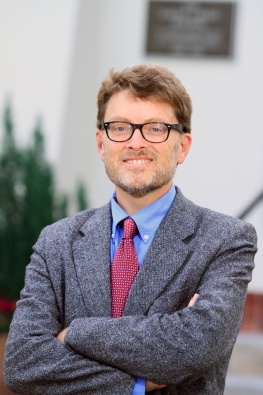
Sunder Ramaswamy
Monterey Institute President
Sunder Ramaswamy became the 13th president of the Monterey Institute of International Studies in January 2009.
Ramaswamy assumed the presidency at a critical juncture for the Monterey Institute, with full integration with Middlebury approaching in July 2010, and a separate but equally ambitious reorganization effort underway. His first priority as president has been to build on the “great momentum” the Institute has achieved over the past few years. “The Institute is a special place, offering a deeply enriching program of international professional graduate education in a unique physical location. More importantly, the commitment and idealism of our students, coupled with the practical skills they acquire through the Institute’s experiential learning approach, position them to be the solution to the world’s most pressing problems.”
Ramaswamy is widely recognized for his scholarly and professional work in international and development economics, particularly in India and Africa. He has written and edited books, authored articles for a variety of scholarly journals focused on development and international economics, delivered presentations at international conferences on four continents, and been quoted in local, national, and international media.
His academic and administrative background is well suited to helping MIIS respond to the challenges ahead and to the emerging needs of 21st-century students. Prior to his transition to Monterey, Ramaswamy served as Middlebury College’s Frederick C. Dirks Professor of International Economics (a position he continues to hold), the dean for faculty development and research, and the project director of the Middlebury-Monterey Integration Task Force. He has also served as the director of the Madras School of Economics in Chennai, India, one of India’s premier institutes for graduate education and economics research.
He received his Ph.D. in economics from Purdue University in 1991, in addition to an M.S. from Purdue, an M.A. in economics from the Delhi School of Economics, and a B.A. in economics from St. Stephen’s College, University of Delhi, India.
Ramaswamy is currently working on projects fostering economic reforms in India. He has also been involved with USAID and INTSORMIL projects on agricultural development in Sub-Saharan Africa. His teaching and other academic work has been supported by grants from the Davis Foundation, Ford Foundation, and Kellogg Foundation. He has also been a consultant to UNCTAD, UNIDO, the United Nations University, and the World Bank.
Ramaswamy, his wife, Varna, and their eight-year-old son, Srivatsan, live in Monterey.
Publications: Authored articles in journals including Agricultural Economics, Agricultural Systems, Applied Economics, Comparative Economic Studies, Economic Development and Cultural Change, Economics Letters, Environment, Food and Nutrition Bulletin, Journal of Development Economics, and Outlook on Agriculture.
Media coverage: Asia Times Online, The Deccan Chronicle, The Diplomatist, The Economic Times, Education World, The Hindu, India Today, India West, Industrial Economist, The Monterey Herald, The New Indian Express, SIFY.com, Time (Asia & Europe editions), and Vermont Public Radio.
Earlier positions:
- Project director, Middlebury-Monterey Integration Task Force
- Dean for Faculty Development and Research, Middlebury College
- Acting Dean of Faculty, Middlebury College
- Director, the Madras School of Economics, Chennai, India
- Chair, economics department, three terms, Middlebury College
Teaching: Recipient of awards and recognitions for his teaching at Purdue University and Middlebury College, including the Marjorie Lamberti Faculty Appreciation Award .
Presentations: In Austria, Canada, Egypt, Greece, Italy, Netherlands, Singapore, Spain, and Zimbabwe. Over 100 talks in seminars and conference/ workshop settings in India and the USA.
Books co-authored or co-edited:
- Development and Democracy: New Perspectives on an Old Debate
- Economics—An Honors Companion
- Social Capital and Economic Development: Well-Being in Developing Countries
- The Economics of Agricultural Technology in Semi Arid Sub-Saharan Africa